
Amanda Cleary Eastep
In her recent presentation at our small town center in Appalachia, Margaret Renkl, essayist at the New York Times and author of The Comfort of Crows and Late Migrations, talked about what we deem as tragedy and recompense in nature. For instance, we may consider the fall of a massive oak to be a tragedy; the recompense–such as the beneficial plants that grow because of its fall–may not be equal to the tragedy.
How do we measure that “equality”? I wonder. What if the seemingly minor recompense benefits the ecosystem (and even the broader creation) in a way humans have no way of understanding or even observing? After all, our knowledge and technology only reveal so much. Perhaps this so-called small outcome and the future fruit of its work can only be seen and used by God.
Of course we have learned–and continue to–that even the tiniest observable creatures are wildly complex. Just like the James Webb Space Telescope has given us a glimpse into a star birth, electron microscopes help scientists to visualize specimens at the atomic level.
I always wonder how far out and how far in God will allow us to see when we can’t see what’s right in front of us:
For since the creation of the world God’s invisible qualities—his eternal power and divine nature—have been clearly seen, being understood from what has been made, so that people are without excuse. Romans 1:20
Margaret and I agree on making a practice of observing the small things in nature. She explained how doing so comforts her, especially when the wider world feels overwhelming (she alluded to the current political climate). For instance, she might sit quietly and closely study and admire a flower petal.
Both the simplicity and the known complexity of the “small” instills awe in me, reminding me God is bigger than the things that can overwhelm me. Without him, we feel small; with him, we can feel safe in our smallness.
In my last Blue Ridge Naturalist class, Beginning Botany, students were reminded that plant photosynthesis happens in a plant’s chloroplasts, organelles that contain chlorophyll. When I look at a leaf, I now know that in one square millimeter, there are 500,000 chloroplasts.
Inside the boundaries of these human-created measurements–a world! One I am too big to exist inside; but not God.
Where a flower petal provides Margaret with an escape, a green leaf testifies to me of the eternal.
If we paid more attention to what I think C.S. Lewis would categorize as “tiny theophanies,”[1] we might better appreciate our smallness in creation, while simultaneously adoring the Creator.
We might observe the constellation of white spots on the black skin of a slimy salamander and feel no fear when we gaze up at the star-studded night sky.
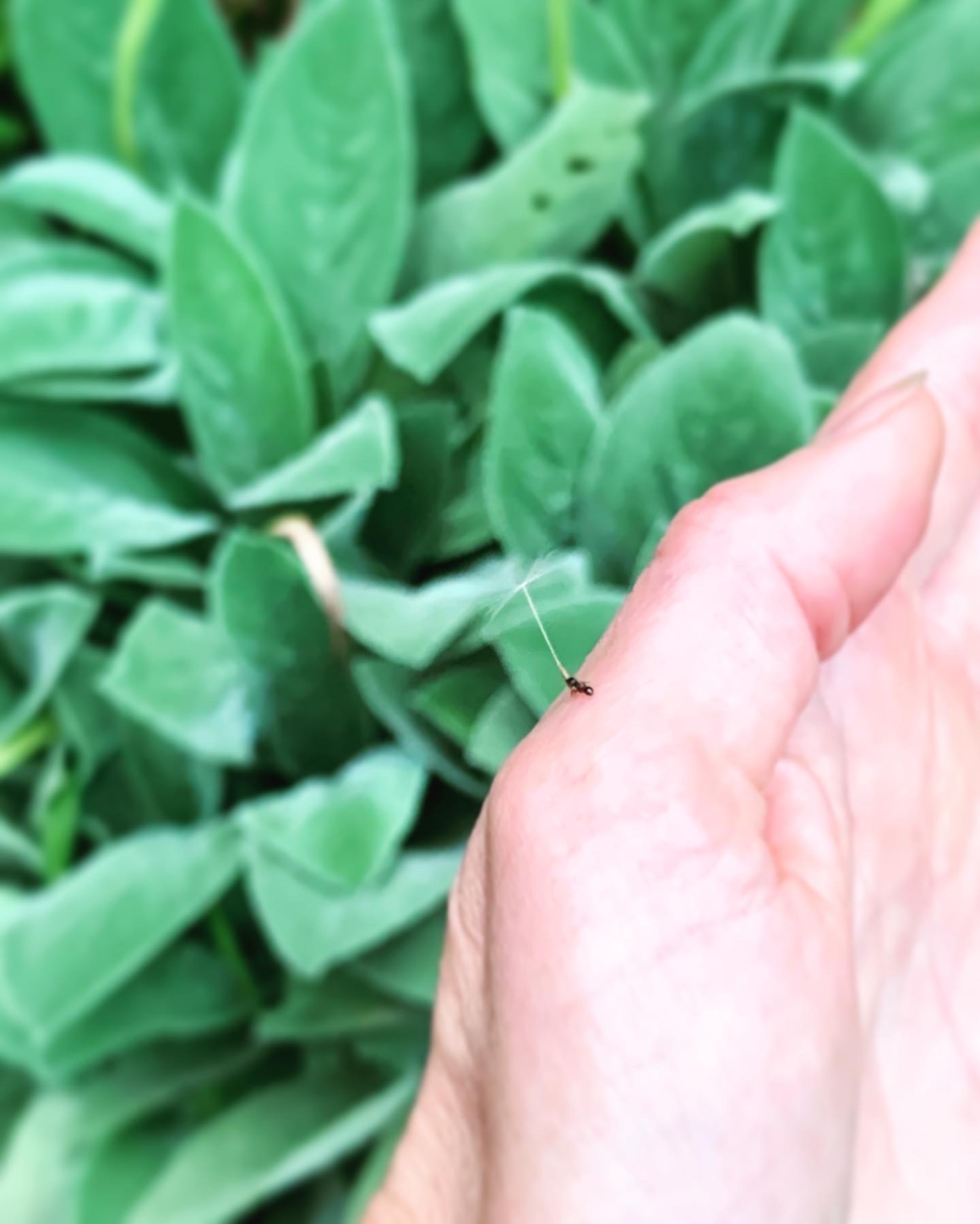
We’d watch an ant struggling over the pebbled path with a dandelion seed, like an open umbrella against the impossibly gigantic sun, and remember that someone lovingly watches over us in our struggles.
In The Comfort of Crows (112), Renkl writes that such noticing means living in the middle of the story:
To pay close attention to the natural world is to exist in medias res. Life is an unfolding that responds to the cues of seasonal change, but for our purposes it is also suspended in an everlasting present. …
In the wild, we see either the story’s vulnerable beginning, or its territorial middle, or its heartbreaking end, but we almost never see more than one of those stages for an individual. We are storytelling animals, and for us that indeterminate space is uncomfortable. We turn the unfinished story over and over in our minds, imagining alternate scenarios. We try to convince ourselves that only the happy ending is possible, that any tragedies we fail to witness are tragedies that never happened. That kind of ignorance is a gift we give ourselves because we are made so uneasy by uncertainty. [emphasis mine]
We won’t always know why the nest on our porch had four hatchlings one week and only three the next. We might not see where the fledglings have gone after leaving the nest. The Creator does know because not one sparrow falls to the ground outside of his care (Matthew 10:28).
Despite our great knowledge and our expanding views into space and into particles, human beings can never know the beginning and the end. (Often, we don’t even understand the middle.) But we also don’t have to accept a gift as poor as ignorance to mollify our abhorrence of uncertainty.
We can instead choose to trust in the love of One who has no beginning and no end, who is the First and the Last.
Maybe the practice of observing nature in all its sizes, complexities, and supposed inequalities would help us to more clearly see the tragedy and the recompense in our spiritual life–the sin we can’t save ourselves from and the death and resurrection of Christ to do that.
Against our beloved smallness, the sacrifice and love of the Creator is all the greater.
*****
For more about the intersection of children’s books, faith, and nature, subscribe to Book Leaves, my free author newsletter.
For a fun and meaningful way to share the idea of stewardship/creation care with kids, check out my The Hunt for Fang, book 2 in my Tree Street Kids series for readers 8-12 (Moody Publishers, Chicago).

 Amanda Cleary Eastep
Astonishing lessons, Amanda. Wow…. “an ant I saw carrying a dandelion seed.” What a wonder–how faithful is God to bring life and beauty out of destruction.
LikeLiked by 1 person
The more I look closely, the more I see. It’s been amazing, Jody!
LikeLike